

One of the best things about Baseball5 is that you can play it almost anywhere. You need a flat surface, a rubber ball and some lines on the ground. But to play by the official rules, the field has to have the right dimensions. Here they are, from the official WBSC Baseball5 Rulebook 2026, followed by how I set up a court quickly for practice.
The official Baseball5 field dimensions
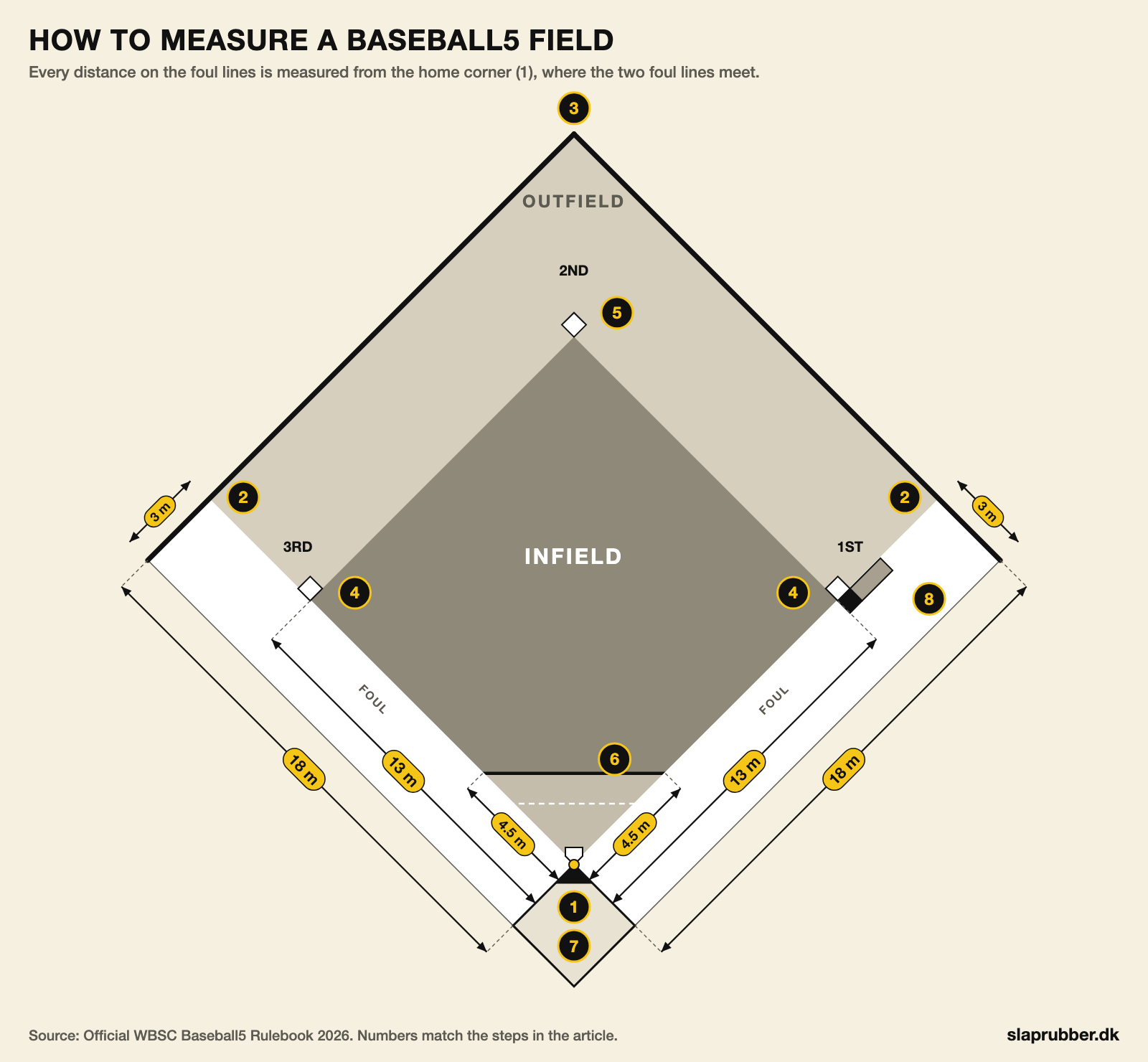
| Part of the field | Size |
|---|---|
| Fair territory | A square, 18 m per side, with one corner at home plate |
| Infield | A square with a base in each corner, 13 m between bases |
| No-hit zone | The area in front of home plate, up to a line joining the points 4.5 m from home along each foul line (3 m for U-15) |
| Batter’s box | A square, 3 m per side, outside fair territory behind home plate |
| Bases | Ideally 60 × 60 cm squares, marked on the ground |
| First base safe area | A doubled base with a 1.5 m safe area in foul territory |
| Lines | 5 cm wide; the no-hit zone line 10 cm |
| Fences | Ideally 100 cm high |
The parts that are different from baseball
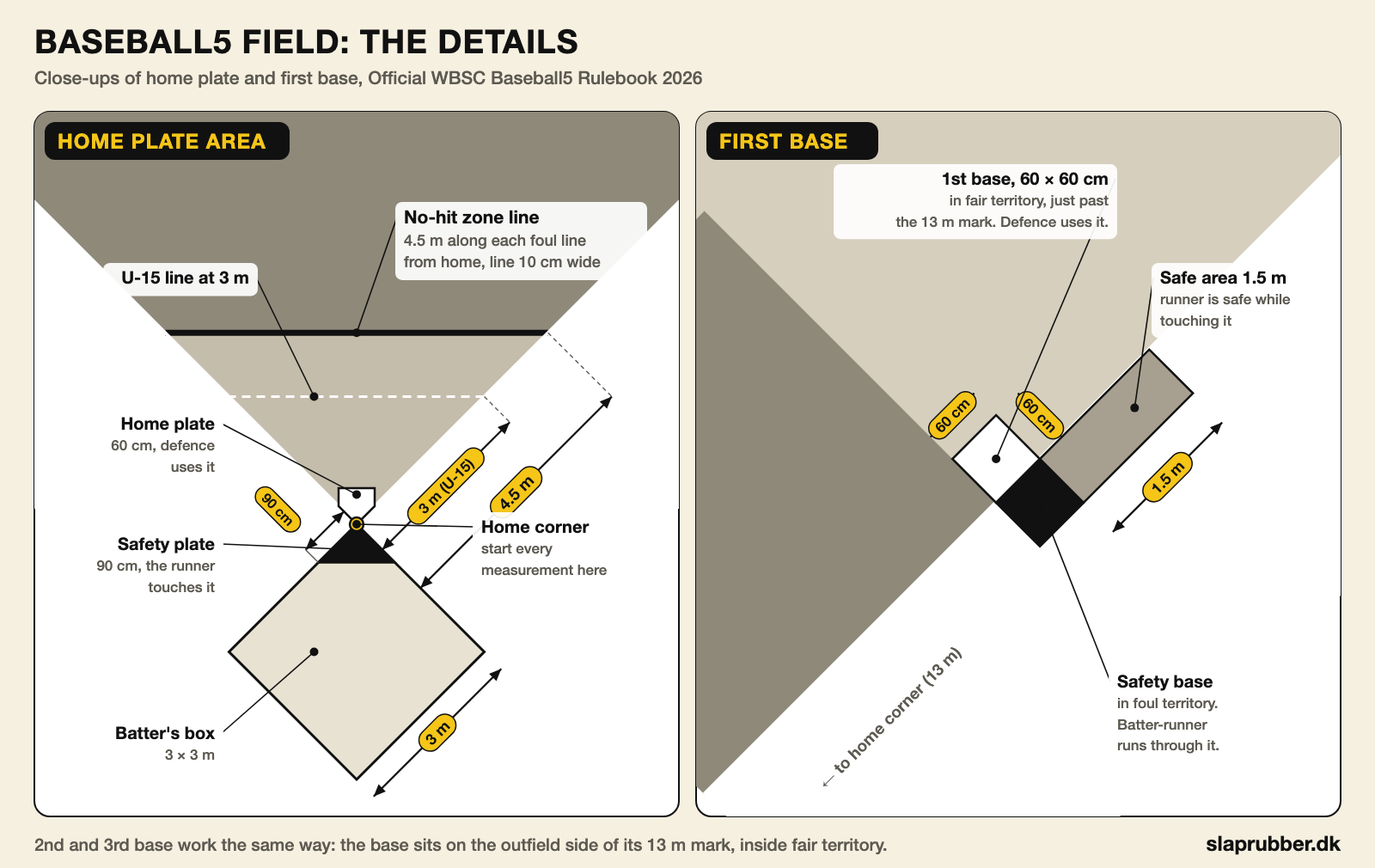
The no-hit zone. A straight line runs from the first base foul line to the third base foul line, 4.5 m from home plate. The first bounce of a batted ball must be on or after this line, so a ball that dies right in front of home plate is an out. For U-15 the line is at 3 m.
The batter’s box sits outside the field. It is a 3 × 3 m square built on the extension of the two foul lines, behind home plate. The batter must stay completely inside it until the ball has left the hand.
First base and home plate are doubled. To avoid collisions, the defence uses one base in fair territory, while the batter-runner runs to a “safety base” in foul territory next to it. At first base, the batter-runner is safe as long as they stay on the safety base or in the 1.5 m safe area attached to it. Home plate has the same idea: the runner touches a “safety plate” in the batter’s box, a triangle of 90 cm per side.
There is a safety zone. Keep an area around the field clear of tables, chairs, cameras and anything else players could run into.
How to measure and mark a Baseball5 field, step by step
You only need a 20 m tape measure, tape or chalk, and someone to hold the other end. The numbers match the diagram at the top of the article.
- Find the home corner, the point where the two foul lines meet. Every distance along the foul lines is measured from this point.
- Measure two foul lines of 18 m at a right angle from the home corner.
- Close the square with two more 18 m lines. That is fair territory. The fence, a wall or a row of benches goes along these two far sides.
- Mark 13 m from the home corner on each foul line. First and third base go just past these marks, inside fair territory and touching the foul line.
- Find second base: the point that is 13 m from both of those marks. Second base goes on the outfield side of it.
- Mark 4.5 m from the home corner on each foul line (3 m for U-15) and join the two marks with a 10 cm wide line. That is the no-hit zone line.
- Extend both foul lines 3 m behind the home corner and close a 3 × 3 m batter’s box. Home plate sits in the corner of fair territory, the safety plate in the corner of the batter’s box.
- Keep 3 m of foul territory outside each foul line. Put the safety base next to first base in foul territory, with the 1.5 m safe area beyond it.
Tape works indoors and chalk outdoors. In a normal handball hall there is room for two courts, so a whole class or team can play at once.
Can you change the dimensions?
For official WBSC competitions, no. But the rules themselves let leagues and organisers decide how to limit the field, for example by using existing walls or marking the ground, as long as the ground rules are clear to everyone. For young players, a shorter no-hit zone, a smaller field and second chances on illegal hits make the game easier to learn.
Want to go deeper?
Setting up a court for a club or school? Non-slip, correctly sized Baseball5 bases make it much faster. See Baseball5 equipment for clubs, or the Baseball5 school set for Danish schools. New to coaching? Start with How to coach Baseball5.
Source: Official WBSC Baseball5 Rulebook 2026. Always check the tournament regulations for official competitions.